

Published: October 13, 2026
Since its launch, the Core Web Vitals initiative has sought to measure the real-world user experience of websites, focusing on user-perceived loading speed, interactivity, and visual stability, rather than implementation details. However, Single-Page Applications (SPAs) have been a gap for the initiative.
Instead of loading distinct HTML documents as a user navigates, SPAs dynamically update page content and the URL using JavaScript—a transition known as a "soft navigation." Since these are handled differently in each implementation, they have required bespoke custom measurement, making it hard to compare directly across sites.
The new experimental metrics
Today, following the launch of the Soft Navigations web platform API in Chrome 151, Chrome is publishing experimental versions of the Core Web Vitals metrics in the Chrome User Experience Report (CrUX) dataset that include soft navigations.
These new experimental CrUX metrics provide a more complete picture of a user's experience on Single-Page Applications. They expand the aggregate data already publicly available in CrUX by reporting experimental versions of the three Core Web Vitals that blend soft navigations with hard navigations:
- Largest Contentful Paint with Soft Navigations (
experimental_largest_contentful_paint_with_softnavs): Measures Largest Contentful Paint (LCP) across both hard and soft navigations. - Interaction to Next Paint with Soft Navigations (
experimental_interaction_to_next_paint_with_softnavs): Measures Interaction to Next Paint (INP) segmented by individual soft navigations as well as hard navigations, rather than attributing every interaction across an entire SPA session to the initial page load. - Cumulative Layout Shift with Soft Navigations (
experimental_cumulative_layout_shift_with_softnavs): Measures Cumulative Layout Shift (CLS) segmented across both hard and soft navigations, evaluating visual stability per individual view and URL.
While these metrics measure the same speed, responsiveness, and visual stability dimensions as Core Web Vitals, Google's stable Core Web Vitals scores remain unchanged while these experimental versions are evaluated alongside them.
We anticipate adding experimental soft-navigation metrics for navigation types and First Contentful Paint (FCP) in the next CrUX release in November.
How Core Web Vitals change with soft navigations
Which sites will see changes
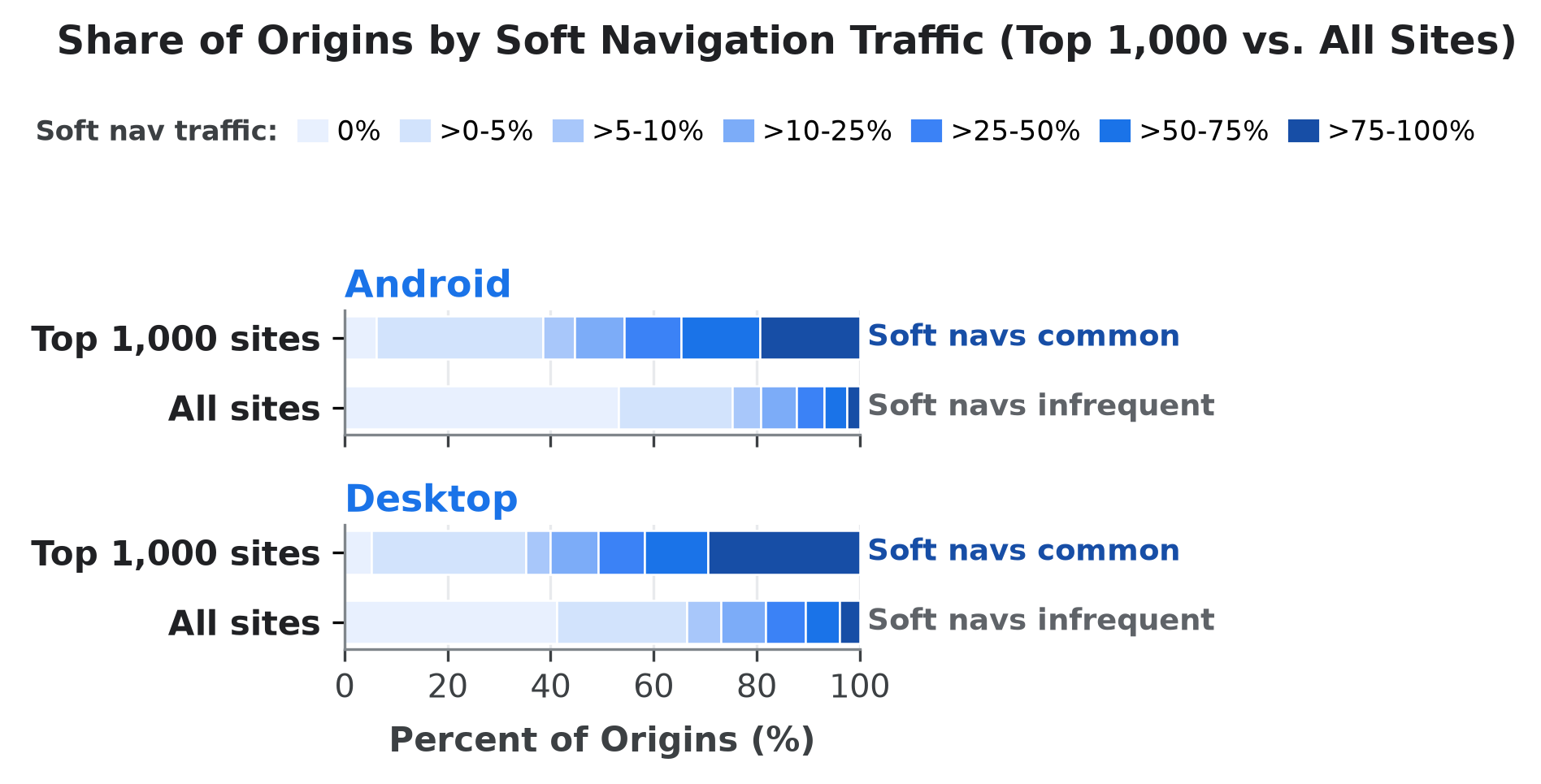
Most websites, such as many blogs, news sites, and standard multi-page websites, load a new HTML page from the server each time a visitor clicks a link. Across all origins in CrUX, around 70% have little to no soft navigation traffic (fewer than 5% of page views are "soft"), and only about 7–11% of origins use soft navigations for more than half of their page views. If your site doesn't use JavaScript to dynamically swap out page content and update the URL without a full browser reload, you shouldn't expect to see any changes in your metrics.
Changes are concentrated on sites that are both built as Single-Page Applications (SPAs) and have a high volume of follow-up navigations, which represent a small share of the overall web, but account for 35–42% of the top 1,000 websites on both Android and Desktop (see Figure 1).
Metric-by-metric impact
Previously, when a user browsed an SPA, CrUX only recorded the initial "hard" page load when the user first arrived on the site, while ignoring subsequent in-app page transitions as separate loads and grouping all interactions and layout shifts from the entire session into that initial landing page. With soft navigations included, each in-app view change that updates both the page content and the URL is measured as its own navigation. In the CrUX API, metrics for each soft navigation are also reported under the specific URL the user navigated to rather than the initial landing page (subject to meeting the usual eligibility criteria), making it much easier to pinpoint and debug issues on individual pages.
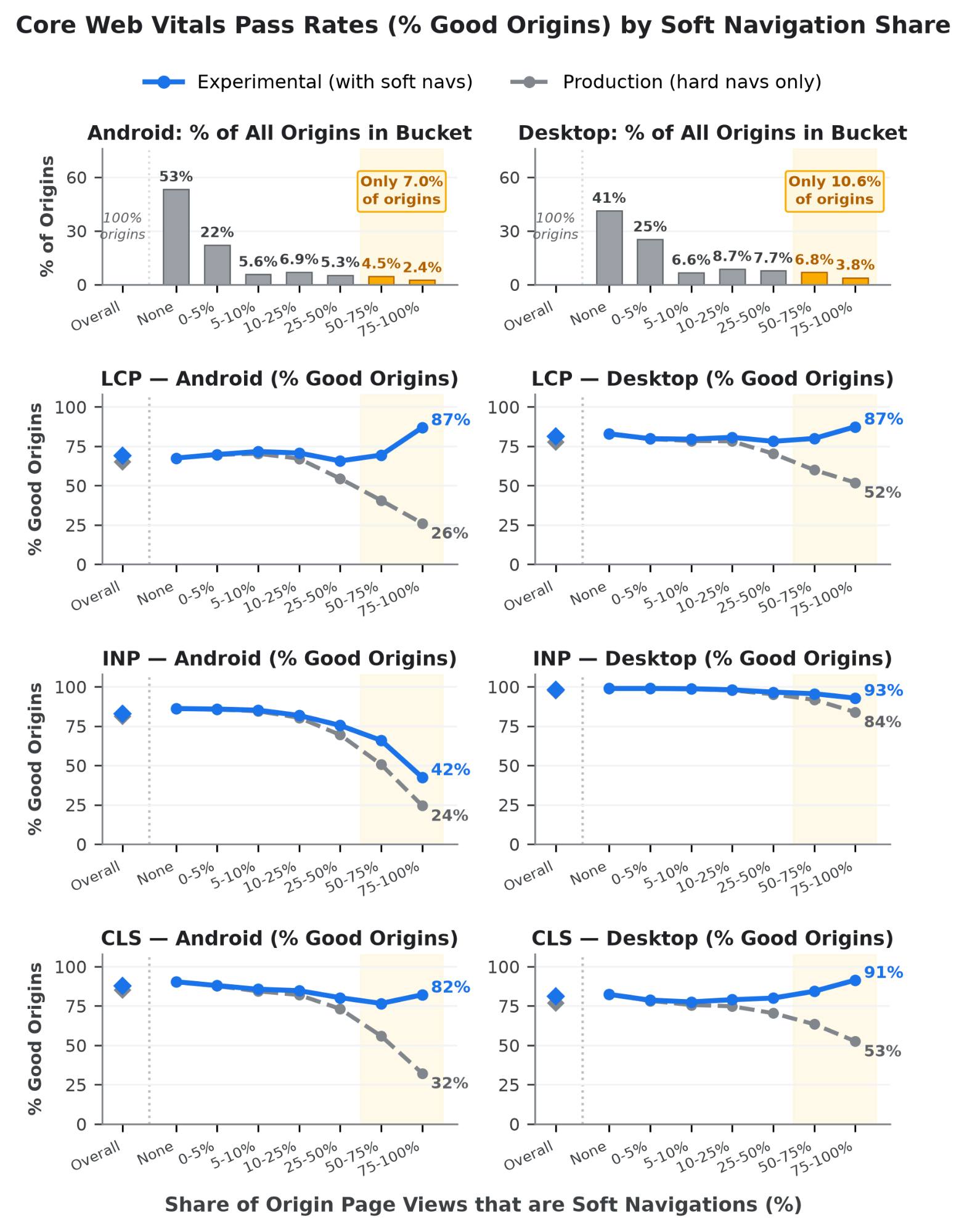
For the small group of sites with a high share of soft navigations (the shaded >50% region on the right of Figure 2), here is how each metric changes:
- Faster and more representative Largest Contentful Paint (LCP): If users click through many follow-up views on your site, you can expect LCP scores to improve because follow-up soft navigations reuse code and assets that were already downloaded on the slower initial page load. In Figure 2, origins with 75–100% soft navigations move from 26% "Good" LCP (dashed grey) to 87% (solid blue) on Android. This isn't because SPAs are faster than multi-page websites (MPAs) overall, but because follow-up clicks are faster on any site, bringing SPAs with many follow-up visits in line with MPAs with many follow-up visits.
- Improved Interaction to Next Paint (INP), though JavaScript work still matters: You'll likely see better INP scores because responsiveness is now measured per page view rather than taking the slowest interaction across an entire browsing session, roughly doubling the Android pass rate for sites with mostly soft navigations. Even with this boost, SPA-heavy sites still trail MPA websites in "Good" INP overall, so heavy main-thread JavaScript work during route transitions may still cause INP issues.
- Improved Cumulative Layout Shift (CLS): You can expect CLS scores to improve as layout shifts are segmented into individual page views rather than accumulated across a longer session, bringing SPA-heavy sites in line with MPA websites on Desktop and nearly matching them on Android.
Access the experimental metrics
You can access these soft navigation metrics in the CrUX BigQuery dataset, CrUX API, and CrUX History API starting with the October 2026 release.
Feedback and next steps
Each of the metrics is labeled "experimental" to make clear we're open to community feedback and issues filed in the soft navigations specification repository as we validate and evolve how soft navigations are measured across the web. We're actively working on addressing feedback, so expect some shifts from month to month as the measurement improves.
We aim to graduate from experimental in May of 2027, subject to feedback. Once graduated, Search Console will switch to use the new data.
For more information about how Chrome detects soft navigations and how to measure them in your own Real User Monitoring (RUM), see our documentation on Measuring soft navigations.